What is a Dry Ridge System and Why Choose It?
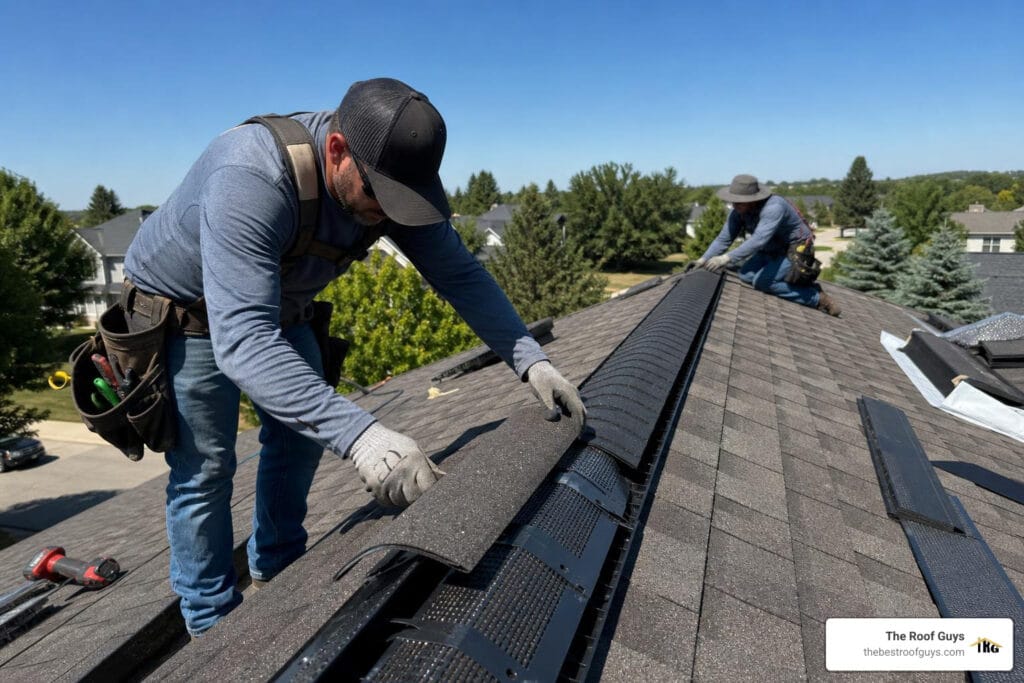
A modern dry ridge system installation is a highly effective, mortar-free roofing solution designed to mechanically secure ridge tiles to the apex of a roof. If you are looking to protect your home with the help of expert roofing contractors, transitioning away from traditional mortar is a smart investment. Traditionally, ridge tiles were bedded in sand-and-cement mortar. While mortar has been the industry standard for decades, it is highly rigid and susceptible to environmental degradation. Over time, the natural settling of a house, coupled with thermal expansion and contraction, causes mortar to shrink, crack, and crumble. This leaves the ridge tiles loose and vulnerable to wind uplift and water infiltration.
In contrast, a dry ridge system utilizes mechanical fixings—such as screws, clamping plates, and brackets—alongside a flexible, weather-resistant ridge roll to secure the tiles. This mechanical approach accommodates the natural thermal movement of the roof structure without compromising its integrity.
Furthermore, dry ridge systems provide built-in roof space ventilation. Proper ventilation is essential for preventing condensation, moisture build-up, and mold growth in the attic. This is particularly crucial in humid coastal areas of Texas, like Conroe TX, Houston, and Pasadena Tx, as well as storm-prone regions in Oklahoma.
Compliance Standards for Dry Ridge Systems
Modern building regulations strictly govern how dry fix systems must perform. High-quality systems, such as the Klober Economy Dry Ridge Kit, are designed and tested to meet rigorous performance standards:
- BS 8612: This standard specifies the performance requirements for dry-fix ridge, hip, and verge systems. It ensures the system can resist wind uplift forces, channel rainwater effectively, and remain durable over its service life.
- BS 5250: This is the code of practice for the control of condensation in buildings. It mandates adequate roof space ventilation to prevent structural decay.
- BS 5534: This code of practice for slating and tiling requires all ridge and hip tiles to be mechanically fixed, effectively making traditional mortar-only installations non-compliant without secondary mechanical fasteners.
Dry Ridge vs. Traditional Mortar Bedding
To help you understand why we recommend dry fix solutions for our residential and commercial clients, here is a direct comparison:
| Feature | Dry Ridge System | Traditional Mortar Bedding |
|---|---|---|
| Fixing Method | Mechanical (screws, plates, brackets) | Adhesion (sand-and-cement mortar) |
| Durability | Long-lasting; unaffected by freeze-thaw cycles | Prone to cracking, crumbling, and falling out |
| Maintenance | Virtually maintenance-free | Requires periodic re-pointing and repairs |
| Ventilation | Integrated continuous ventilation | None (requires separate ridge vents) |
| Installation Weather | Can be installed in freezing or wet conditions | Requires dry, frost-free weather to cure |
| Wind Resistance | High; tested to resist extreme wind uplift | Moderate; prone to failure if mortar degrades |
| Flexibility | Accommodates natural thermal expansion | Rigid; cracks under structural movement |
By eliminating wet mortar, we can carry out installations year-round, even during cold snaps in Tulsa or Oklahoma City, without worrying about frost ruining the mix.
Essential Components of a Dry Ridge Kit
A typical dry ridge kit comes packaged with all the necessary components to complete a standard run (usually 3 to 6 meters, depending on the manufacturer). Understanding what each component does is key to a successful dry ridge system installation.
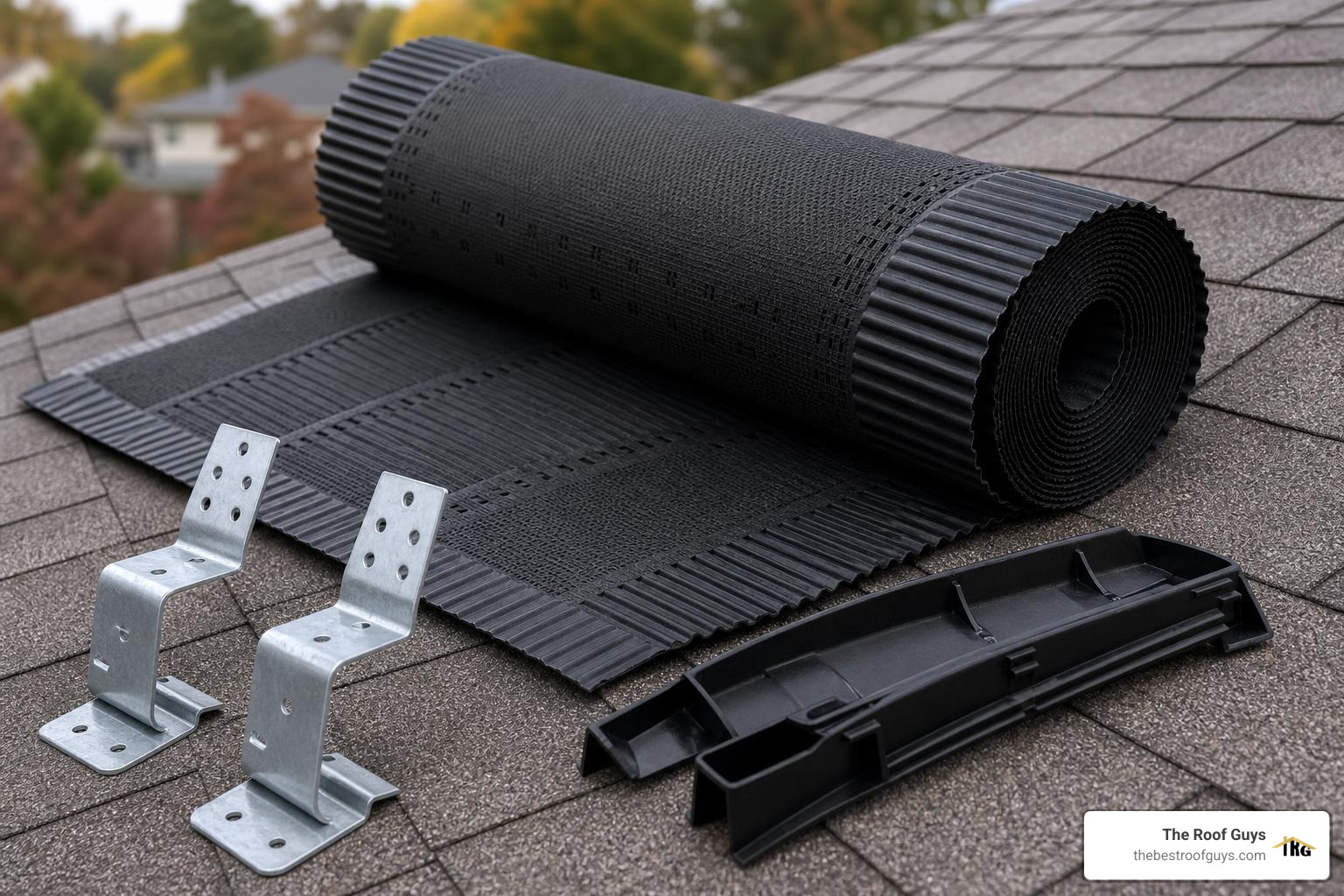
Here are the primary components included in a standard kit:
- Ventilated Ridge Roll: A long, flexible roll (usually 300mm wide) made of a water-resistant membrane with corrugated aluminum or copper edges. The center of the roll allows air to pass through while blocking driving rain and insects. The edges feature high-tack butyl adhesive strips that seal directly to the top course of roof tiles.
- Batten Support Brackets: Galvanized or stainless steel brackets that fix directly to the rafters. These brackets hold the ridge timber batten securely at the correct height, ensuring it does not wobble or shift.
- Ridge Unions (or Ridge Seals): Polypropylene or rubber joints placed between adjacent ridge tiles. They provide a weather-tight seal between the tiles, prevent water from driving underneath, and feature built-in slots to guide the mechanical fixings.
- Clamping Plates (or Washers): Small metal or plastic plates that sit on top of the ridge unions. They distribute the clamping force of the screw evenly across the edges of the two adjacent ridge tiles, preventing them from cracking when tightened.
- Stainless Steel Screws and Neoprene Washers: Long, corrosion-resistant screws (typically 100mm to 120mm in length) that pass through the clamping plate and ridge union, securing deep into the timber ridge batten. The neoprene washer creates a watertight seal around the screw head.
- Batten Straps: High-strength stainless steel straps used to secure the ridge batten directly to the roof rafters when batten brackets are not utilized.
Step-by-Step Dry Ridge System Installation Guide
Installing a dry ridge system requires precision, patience, and adherence to manufacturer guidelines. While the process does not require highly specialized tools, it demands strict attention to detail to ensure the roof remains completely watertight. If you want to dive deeper into the technical specifications, you can refer to the Universal Dry Fix Ridge System Installation Guide.
Before beginning, we always recommend reviewing the best roof installation practices for long-term durability to set yourself up for success.

Preparing the Roof Apex for Dry Ridge System Installation
The preparation stage is the foundation of your entire installation. Skipping steps here will inevitably lead to ventilation failures or loose tiles.
- Prepare the Underlay: Lay your roofing underlay as normal. If roof space ventilation is required (which it almost always is), do not wrap the underlay over the apex. Instead, cut the underlay short of the apex on both sides to leave a continuous 30mm ventilation gap (or a 5mm to 8mm gap depending on the specific product specifications, such as Manthorpe’s guidelines).
- Fix the Batten Support Brackets: Place a batten support bracket at every rafter apex. Secure them using corrosion-resistant annular ring shank nails (typically 30mm stainless steel nails). These brackets feature specific bending points (often numbered 1 to 4) to accommodate different tile heights and roof pitches. Adjust them so the timber ridge batten sits at the correct height.
- Install the Ridge Batten: Slide a 50mm x 25mm (or 50mm x 50mm) timber ridge batten into the brackets. Secure the batten to the brackets by bending the metal up-stands over the timber and securing them with 25mm stainless steel nails. If you are using batten straps instead of brackets, wrap the strap over the ridge batten and fix it to the rafters using at least two 25mm clout head nails on each side, spaced at a maximum of 600mm centers.
- Position the Top Course Tiles: Lay and fix your roof tiles up to the top course. Ensure the top tiling batten is positioned to allow the correct head lap for your specific tile profile, leaving a clean, flat surface for the ridge roll to adhere to. The tiles must be completely dry and free of dust, moss, or debris before proceeding.
Securing the Ridge Roll and Tiles During Dry Ridge System Installation
With the structural framework in place, you can now install the weatherproofing layers.
- Unroll the Ridge Roll: Center the ventilated ridge roll over the newly installed timber ridge batten. Temporarily secure it in place along the center spine using corrosion-resistant staples or felt nails at 300mm intervals.
- Join the Rolls: If your ridge line is longer than a single roll, you must join the rolls together. Ensure a minimum overlap of 75mm (some manufacturers, like Manthorpe, require 100mm) to prevent water penetration at the joint. Secure the overlap with a staple or nail through the center of the lap.
- Adhere to the Tiles: Remove the protective release paper from the butyl adhesive strips on the underside of the roll’s corrugated edges. Working from one end to the other, carefully press the corrugated edges down onto the top course of tiles. Ensure the roll conforms tightly to the profile of the tiles, especially if you are working with high-profile concrete or clay tiles. Use a small hand roller if necessary to guarantee a continuous, watertight seal.
- Position the Ridge Tiles: Place your first ridge tile (typically starting with a block-end tile or a ridge end cap at the gable end) over the ridge roll.
- Insert the Ridge Unions: Slide a polypropylene ridge union under the open end of the ridge tile. Position the next ridge tile snugly against the union. Leave a small gap (approximately 3mm) between the tiles to allow clearance for the central locating tongues of the union.
- Mechanically Fix the Tiles: Insert a 100mm (or 120mm) stainless steel screw through the clamping plate, down through the center hole of the ridge union, and drive it directly into the timber ridge batten. Tighten the screw until the clamping plate firmly secures the edges of both ridge tiles. The screw must achieve a minimum penetration of 15mm (and up to 40mm for certain systems like Condron) into the ridge batten to resist wind uplift.
- Secure the Ends: At gable ends, ensure you use a dedicated block-end ridge tile or a mechanical ridge end cap. Never use small, cut ridge tiles at the end of a run. If a cut tile is necessary, ensure it is positioned adjacent to the full end tile, and always drill a secondary 5mm fixing hole to secure it mechanically.
Adapting Dry Ridge Systems for Hips and Junctions
Hip lines (the inclined intersections where two roof slopes meet) present unique challenges for weatherproofing. Because water runs down the hip, a standard ridge kit must be adapted with specialized components to prevent leaks.
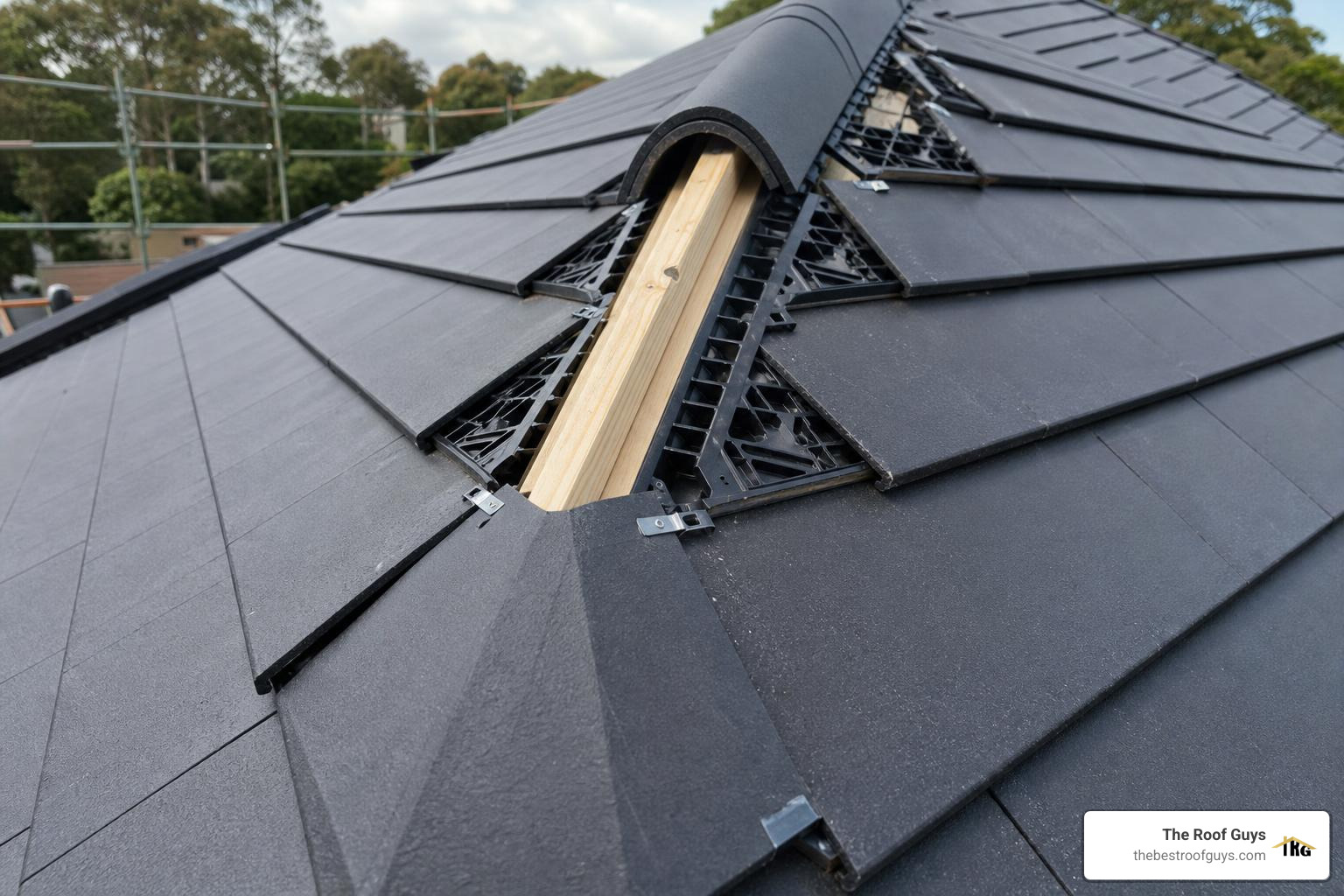
When converting a dry ridge system for hip applications, follow these essential steps:
- Install Hip Battens: Fix 50mm x 50mm timber hip battens along the hip rafter. Ensure they are secured firmly to the structure.
- Cut Roof Tiles Neatly: Lay and tile the roof slopes as normal, cutting the tiles neatly along the hip line. Ensure that no cut tile edge is further than 30mm from the hip batten.
- Secure Cut Tiles: Small, cut tiles on a hip are highly susceptible to slipping or being blown away by high winds. You must secure every cut tile. Use specialized stainless steel fixing clips with teeth that bite into the cut edge of the tile, then nail or wire them directly to the tiling batten. To avoid common pitfalls, review our guide on roof installation mistakes to avoid.
- Fit Hip Support Trays: To keep the hip ridge tiles perfectly aligned and prevent them from rocking, lay PVC hip support trays from the bottom of the hip (the eaves) upward. Cut the first tray in half and mitre it to match the eaves line. Overlap each subsequent full tray by 50mm.
- Apply the Hip Roll: Center the ventilated hip roll over the hip batten. Secure it at 300mm centers with staples or nails. Peel the adhesive backing and press the corrugated edges firmly onto the cut tiles.
- Fix Hip Ridge Tiles: Install the hip ridge tiles from the bottom up. Secure each tile using hip unions, clamping plates, and long screws driven into the hip batten.
- Mitre the Apex Junction: Where the hip line meets the main horizontal ridge, you must carefully mitre the intersecting ridge tiles. Cut them precisely to form a tight, clean joint.
- Seal the Apex: Because mitred joints cannot rely solely on standard unions, install a lead saddle or a dedicated apex soaker beneath the junction. Seal the cut edges of the tiles using a high-quality, roofing-grade waterproof sealant. For more detailed instructions, consult the Condron Dry Ridge System Installation Guide.
Frequently Asked Questions about Dry Ridge Systems
What roof pitches and tile profiles are compatible with dry ridge systems?
Most universal dry ridge systems are compatible with roof pitches ranging from 15 to 45 degrees on standard duo-pitch roofs.
In terms of tile profiles, universal kits are designed to work with almost all concrete and clay tiles, including:
- Flat tiles (such as modern concrete slates)
- Low-profile interlocking tiles
- High-profile tiles (such as double Romans)
However, there are a few exceptions. Universal systems are generally incompatible with highly specialized or deep-profile pantiles (such as Redland Delta tiles). If you are working with traditional 300mm clay ridge tiles, you will need to purchase a specific conversion kit, as standard kits are optimized for longer 450mm concrete ridge tiles.
How does a dry ridge system maintain roof ventilation?
A dry ridge system provides continuous high-level ventilation by utilizing a vapor-permeable membrane in the center of the ridge roll. This membrane allows warm, moist air to escape from the attic void while acting as a barrier against driving rain, snow, and nesting insects.
Most high-quality systems provide a measured geometric free area of 5,000mm² per linear meter of ventilation (equivalent to a continuous 5mm gap), which fully complies with BS 5250 standards. Some heavy-duty systems, like the Condron Dry Ridge, provide up to 20,000mm²/m of net free ventilation area for enhanced airflow in high-condensation environments.
What maintenance is required for a dry ridge system?
Unlike mortar-bedded roofs that require regular re-pointing, a dry ridge system is virtually maintenance-free. However, we highly recommend performing an annual visual inspection as part of your routine roof maintenance checklist.
During your inspection, look for:
- Loose or backing-out screws: High winds and structural settling can occasionally loosen mechanical fixings over several years.
- Lifting adhesive strips: Ensure the butyl adhesive on the ridge roll remains firmly bonded to the tiles and hasn’t been lifted by debris or severe storm winds.
- Damaged end caps: Check that the plastic end caps or block-end tiles at the gable ends remain securely attached and haven’t cracked due to UV exposure.
Conclusion
Upgrading to a dry ridge system is one of the most effective ways to protect your home from leaks, wind damage, and attic condensation. By eliminating fragile mortar and replacing it with a fully mechanical, ventilated system, you ensure your roof remains secure for decades.
At The Roof Guys, we specialize in providing high-quality residential and commercial roofing solutions across Texas and Oklahoma. Whether you are located in Houston, Conroe TX, Pasadena Tx, The Woodlands, Huntsville, Spring, Katy, Tulsa, or Oklahoma City, our expert teams are ready to assist. We back our work with an ultra-fast turnaround, expert storm response, and a comprehensive 10-year warranty for ultimate peace of mind.
Ready to secure your roof’s apex? Contact us today to learn more about our professional roof installation services or to schedule a professional inspection.