Understanding the Seamless Aluminum Gutter Install Process
To ensure a successful seamless aluminum gutter install, select a qualified contractor who fabricates continuous troughs on-site, fastens hidden hangers directly to structural rafter tails, and provides verified licensing, insurance, and written workmanship warranties. A seamless aluminum gutter system consists of continuous metal troughs custom-extruded on-site to match the exact dimensions of a home’s roofline, eliminating leak-prone mid-span joints.
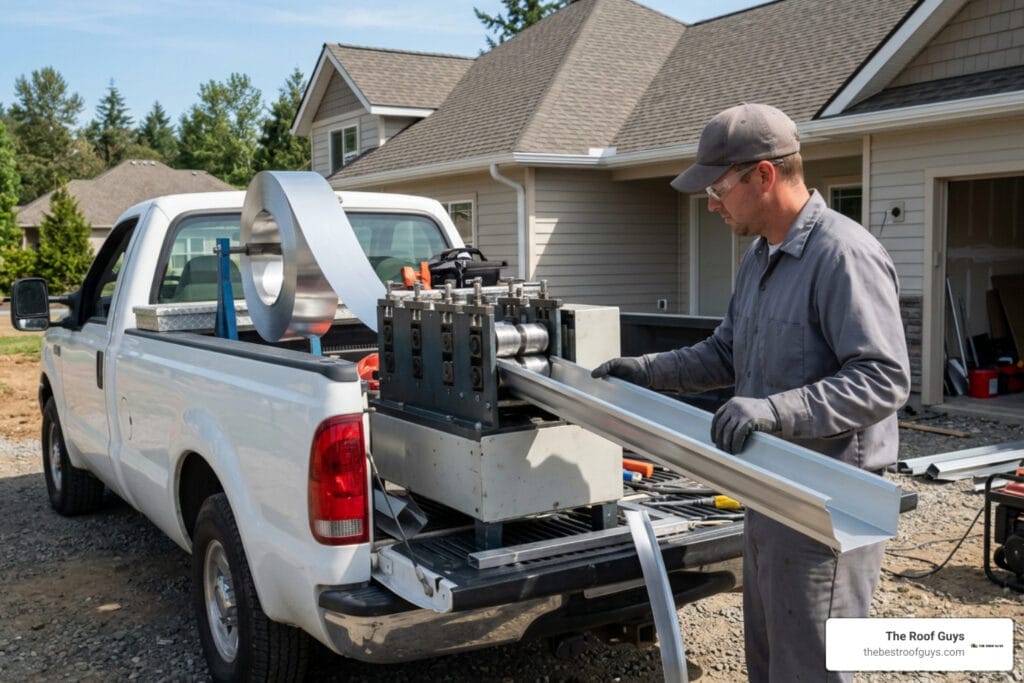
We use specialized truck- or trailer-mounted roll-forming machines that take flat, painted aluminum coil stock and shape it directly at the jobsite. For maximum strength and longevity, standard installations rely on commercial-grade 3105-H24 aluminum alloy. This specific temper provides the rigidity needed to resist thermal warping and withstand heavy water loads without adding excessive weight to the fascia board.
Most residential properties utilize 5-inch or 6-inch K-style profiles. A 5-inch K-style gutter handles standard residential rainfall volumes, while a 6-inch profile increases water-carrying capacity by roughly 40 percent—making it ideal for larger roofs, steep pitches, or regions prone to intense downpours. Choosing an aluminum gutter installation a lightweight and durable gutter solution ensures the drainage system resists rust, handles thermal expansion gracefully, and delivers long-term roofline protection.
Key Steps in a Seamless Aluminum Gutter Install
A dependable installation follows a strict sequence to guarantee water moves smoothly off the roof and away from the foundation:
- Fascia Inspection and Preparation: We inspect the existing wood fascia boards for rot, cracks, or loose fasteners. Any compromised wood is repaired or replaced before mounting new hardware.
- Slope Calculation and Chalk Line Marking: The installation team establishes the high point of each run and snaps a chalk line to establish a downward slope toward the downspout locations.
- On-Site Extrusion: Using the roll-forming machine, our crew extrudes continuous aluminum channels cut to the precise millimeter-level measurement of each eaves run.
- Outlet Hole Cutting and End Cap Sealing: Downspout outlet holes are precisely cut, and end caps are attached and sealed using high-grade exterior elastomeric sealant.
- Hidden Hanger Installation: Heavy-duty hidden hangers are inserted along the inside lip of the gutter channel at engineered intervals.
- Mounting to Fascia: The continuous run is lifted into place and fastened securely through the fascia and directly into structural rafter tails.
- Downspout Assembly and Flow Testing: Downspouts, elbows, and wall brackets are installed, followed by a water flow test to verify rapid drainage without pooling.

When homeowners book professional seamless gutter installation services, this systematic approach eliminates guesswork and prevents common structural failures.
Equipment Required for a Seamless Aluminum Gutter Install
Professional seamless installations require dedicated machinery and commercial hand tools:
- Portable Roll-Forming Machine: Custom-shapes raw aluminum coil into finished K-style or half-round profiles directly on the jobsite.
- Heavy-Duty Rivet Guns: Fastens end caps, miters, and downspout components securely without stripping out thin sheet metal.
- Aviation Snips (Left, Right, and Straight Cut): Used to make clean, burr-free cuts in aluminum when trimming corners and cutting downspout drop outlets.
- Specialized Gutter Sealant (such as GS121 or high-grade elastomeric polymers): Creates waterproof, UV-resistant seals at corners, end caps, and outlet flanges that remain flexible across extreme temperature swings.
- Cordless Impact Drivers and Magnetic Nutsetters: Drives heavy-gauge structural screws through hidden hangers, sub-fascia, and rafter tails.
- Laser Levels and Chalk Lines: Ensures precise, visible slope lines along extensive spans.
Why Choose Continuous Aluminum Over Traditional Sectional Systems
The primary reason building professionals favor seamless systems is the complete elimination of mid-span seams. Traditional sectional gutters join short metal or vinyl pieces every 10 to 12 feet. Over time, temperature fluctuations cause these joints to expand and contract, breaking the adhesive seal and creating chronic leak points that rot fascia and saturate perimeter soils.
Investing in seamless gutters the benefits of smooth continuous gutter systems provides uninterrupted water transit along the entire roof edge. Continuous gutters deliver a clean, architectural finish that blends seamlessly with modern rooflines while eliminating the snag points where leaves, twigs, and debris commonly lodge and cause blockages.
| Feature / Metric | Seamless Aluminum Gutters | Sectional Vinyl Gutters | Sectional Aluminum Gutters |
|---|---|---|---|
| Joint Frequency | Corners and end caps only | Every 10 feet | Every 10 to 20 feet |
| Leak Risk | Low (no mid-run seams) | High (gaskets degrade rapidly) | Moderate (sealant fails at seams) |
| Lifespan | 20 to 30+ Years | 10 to 15 Years | 15 to 20 Years |
| Corrosion Resistance | Excellent (non-rusting) | High (plastic) | Excellent (non-rusting) |
| Storm & Wind Durability | High (screwed to rafter tails) | Low (brittle in cold/UV) | Moderate (seams weaken under load) |
| Custom Fit | 100% custom cut on-site | Requires overlapping pieces | Requires overlapping pieces |
Critical Standards for Quality Installation and Water Management
Proper gutter pitch prevents standing water, insect breeding, and destructive overflow. A continuous aluminum run must be sloped at a minimum rate of 1/4 inch of fall for every 10 feet of horizontal run toward the designated downspout outlet. On runs exceeding 40 feet, the gutter is typically pitched downward in both directions from a central high point toward downspouts located at opposite corners.
Understanding how gutter installation protects your roof and foundation from water damage highlights why structural fastening matters. Hidden hangers must be secured using 1.5-inch to 2-inch corrosion-resistant hex head screws driven through the fascia board and directly into the structural rafter tails behind it. Nailing gutters or screwing solely into decorative fascia cladding allows heavy water and storm debris to rip the gutters loose from the building. For additional context on proper hardware techniques, consult How To Install Aluminum Gutters – This Old House.
Downspout Placement and Foundation Drainage
Downspouts provide the primary exit path for collected roof runoff and must match the total surface area of the roof. As an engineered rule of thumb, installers provide at least one standard downspout (2×3 inch or 3×4 inch) for every 30 to 40 linear feet of gutter run.
To ensure complete water mitigation, downspouts must discharge runoff a minimum of 4 to 6 feet away from the foundation walls. In regions subject to heavy downpours, installers integrate several drainage strategies:
- Concrete or Composite Splash Blocks: Disperse high-velocity water across lawns and prevent topsoil erosion near the slab.
- Hinged or Roll-Out Extensions: Direct runoff past foundation backfill zones during heavy storms and flip up for easy lawn mowing.
- Subsurface PVC Drainage Lines: Connect downspouts directly to buried solid PVC pipes that route runoff to daylight, catch basins, or municipal storm sewers away from structural foundations.
Discovering how seamless gutters improve your homes water management system helps homeowners select the right combination of downspout sizes and drainage routing for their property’s topography.
How to Vet and Select a Qualified Gutter Contractor

Choosing the right installation team requires evaluating their technical process, licensing, and accountability. Because seamless gutters require dedicated on-site fabrication machinery, working with an established exterior contractor guarantees that equipment is calibrated correctly and metal gauges match specifications.
Review what you need to know about seamless gutter installation options and verify these critical items with every prospective installer:
- Proof of Licensing and Comprehensive Insurance: Confirm the contractor maintains general liability coverage and full workers’ compensation for all crew members on your property.
- Itemized Line-Item Estimates: A professional quote clearly specifies metal gauge thickness (minimum 0.027 inch, with 0.032 inch preferred for heavy weather), profile size, hanger spacing intervals, downspout dimensions, and fascia repair costs.
- Written Workmanship Warranties: Look for contractors offering extensive labor warranties in addition to material finish warranties. The Roof Guys backs installations with a dedicated 10-year workmanship warranty.
- Local Physical Presence and Storm Experience: Choose a company with deep regional roots in Texas and Oklahoma that understands local storm dynamics and heavy rainfall patterns.
Frequently Asked Questions About Seamless Gutter Installation
How long does a seamless aluminum gutter system last?
A professionally installed seamless aluminum gutter system has an expected lifespan of 20 to 30 years. Aluminum forms a natural aluminum oxide coating that prevents rust and corrosion. Routine biannual cleaning, post-storm inspections, and keeping trees trimmed away from the roofline ensure maximum service life.
How much slope is required for proper gutter drainage?
Gutters require a slope of 1/4 inch per 10 feet of horizontal run toward the downspout. This pitch allows water to flow quickly enough to carry light sediment without creating an excessively tilted visual line against the home’s roof edge.
What is the standard hanger spacing for aluminum gutters?
Standard hidden hanger spacing is 24 inches on center along the entire gutter run. In areas subject to heavy tropical storms, severe wind loads, or occasional freezing precipitation, spacing hangers every 18 inches increases structural load capacity and prevents sagging.
Conclusion
According to industry data from market analyses, continuous-run seamless gutters represent more than 75% of all residential gutter installations across the United States. Furthermore, recent building performance surveys indicate that foundation water intrusion repairs average over $4,500 nationwide—a cost overwhelmingly caused by inadequate roof runoff management and failed sectional gutter joints.
At The Roof Guys, we provide precision-engineered continuous aluminum gutter systems built to withstand the toughest Texas and Oklahoma storms. From Conroe, Pasadena, and Houston to The Woodlands and surrounding communities, our certified crews deliver ultra-fast turnaround times, dedicated storm response, and an industry-leading 10-year workmanship warranty. Protect your roof, siding, and foundation today with our reliable gutter installation services.