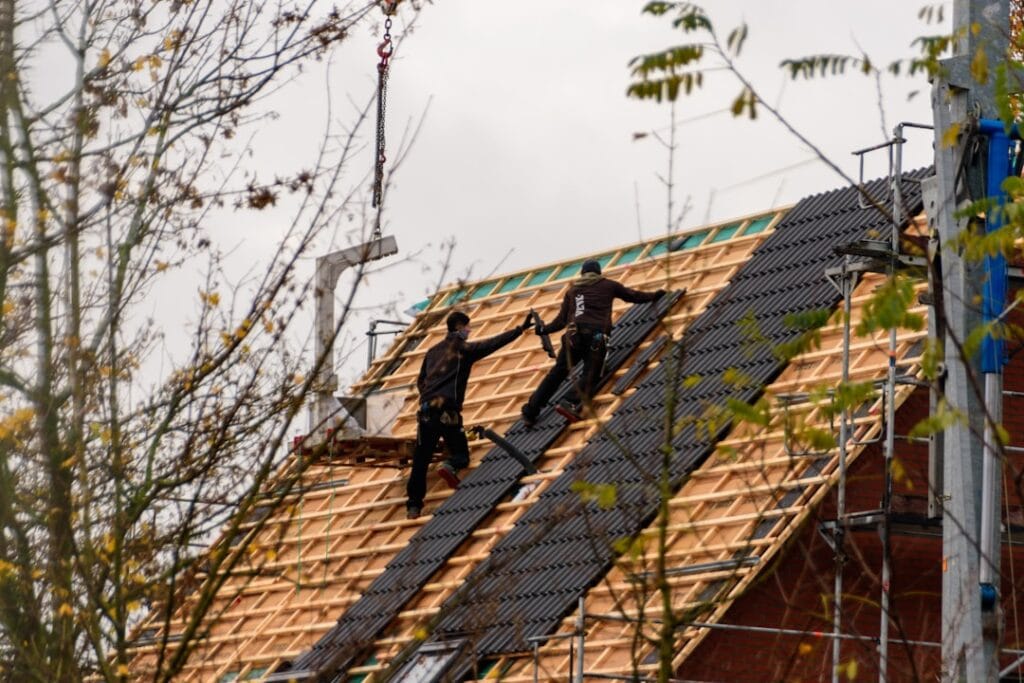
Understanding the Types of Insulated Roof Panels
Before we dive into the installation process, understanding the different types of materials is essential when installing insulated roof panels to ensure long-term energy efficiency and structural durability. Whether you are upgrading a residential home with a trusted local roofing company, building a commercial warehouse, or installing a shaded patio, your choice of panel will directly impact the durability, ease of installation, and thermal performance of your roof.
There are three main types of insulated roof systems:
- Insulated Metal Panels (IMPs): These consist of a rigid foam core sandwiched between two metal sheets (usually steel or aluminum). IMPs are highly durable, provide an average R-value of approximately 7.5 per inch, and are popular for commercial, industrial, and high-end residential applications. They can be manufactured in continuous lengths up to 50 feet.
- Structural Insulated Panels (SIPs): Typically made of an Expanded Polystyrene (EPS) foam core sandwiched between two structural skins, such as Oriented Strand Board (OSB). SIPs act as both the structural framing and the insulation, making them excellent for whole-house construction.
- Foam-Core Patio Panels: These are lightweight, aluminum-faced foam panels designed primarily for outdoor living spaces like patios, carports, and pergolas. They offer excellent walkability, absorb heavy rain noise, and are highly resistant to coastal corrosion.
Choosing the right material is a key step in exploring eco-friendly roof installation options for sustainable living. Let’s compare these three options across several critical performance metrics:
Performance Comparison Table
| Feature | Insulated Metal Panels (IMPs) | Structural Insulated Panels (SIPs) | Foam-Core Patio Panels |
|---|---|---|---|
| Core Material | Polyisocyanurate (PIR) or Polyurethane | Expanded Polystyrene (EPS) | EPS or Polyurethane |
| Skins | Steel or Aluminum | Oriented Strand Board (OSB) | Thin Aluminum or Steel |
| R-Value per Inch | Approx. 7.2 to 7.5 | Approx. 4.0 to 4.5 | Approx. 4.0 to 5.0 |
| Primary Use | Commercial & Industrial Roofs | Residential & Light Commercial | Patios, Carports, Pergolas |
| Span Capability | High (fewer purlins needed) | Medium (requires support framing) | Medium (great for open structures) |
| Moisture Resistance | Excellent (impervious metal skins) | Moderate (OSB must stay dry) | High (corrosion-resistant skins) |
For commercial and large-scale industrial projects, systems like Metl-Span Insulated Metal Roof Panels provide some of the highest thermal efficiencies and structural spans available. If you are planning an outdoor living space, opting for dedicated Insulated Patio Roof Panels ensures a clean, pre-finished underside that doubles as a ceiling, saving you both time and finishing costs.
Structural Requirements and Pitch Specifications for Installing Insulated Roof Panels
You cannot simply throw insulated panels onto any framing and hope for the best. Because these panels act as large, continuous structural elements, the underlying framing must meet precise tolerances.
1. Structural Alignment Tolerances
Your roof purlins or trusses must be perfectly aligned. The industry standard for structural alignment is 0 inches inward and no more than 1/2 inch outward of the theoretical roof plane. If your framing is out of alignment, the panels will not engage or seam properly. This leads to “dog-legging” (where panels drift out of square), which ruins the aesthetics, causes seal failures, and makes it incredibly difficult to install perimeter trims. Always correct misaligned supports before you begin installing insulated roof panels.
2. Minimum Roof Pitch Requirements
The minimum roof slope you need depends entirely on the panel profile and whether you have joints running across the roof.
- Continuous Single Panels: For panels running from ridge to eave without any transverse end laps (such as Kingspan KS1000 RW), the minimum recommended roof pitch is 7% (approximately 4°).
- End-Lapped Panels: If your roof run is long enough to require overlapping panels (transverse joints), the minimum pitch increases to 10% (approximately 6°) to ensure water drains away from the lap joints.
- Specialized Flat Roof Systems: Advanced commercial deck panels (like Kingspan X-DEK) can be installed on slopes as low as 1% when paired with a continuous membrane system.
For highly detailed structural specifications and load tables, refer to the Kingspan Installation Guide.
On-Site Preparation, Storage, and Handling Best Practices
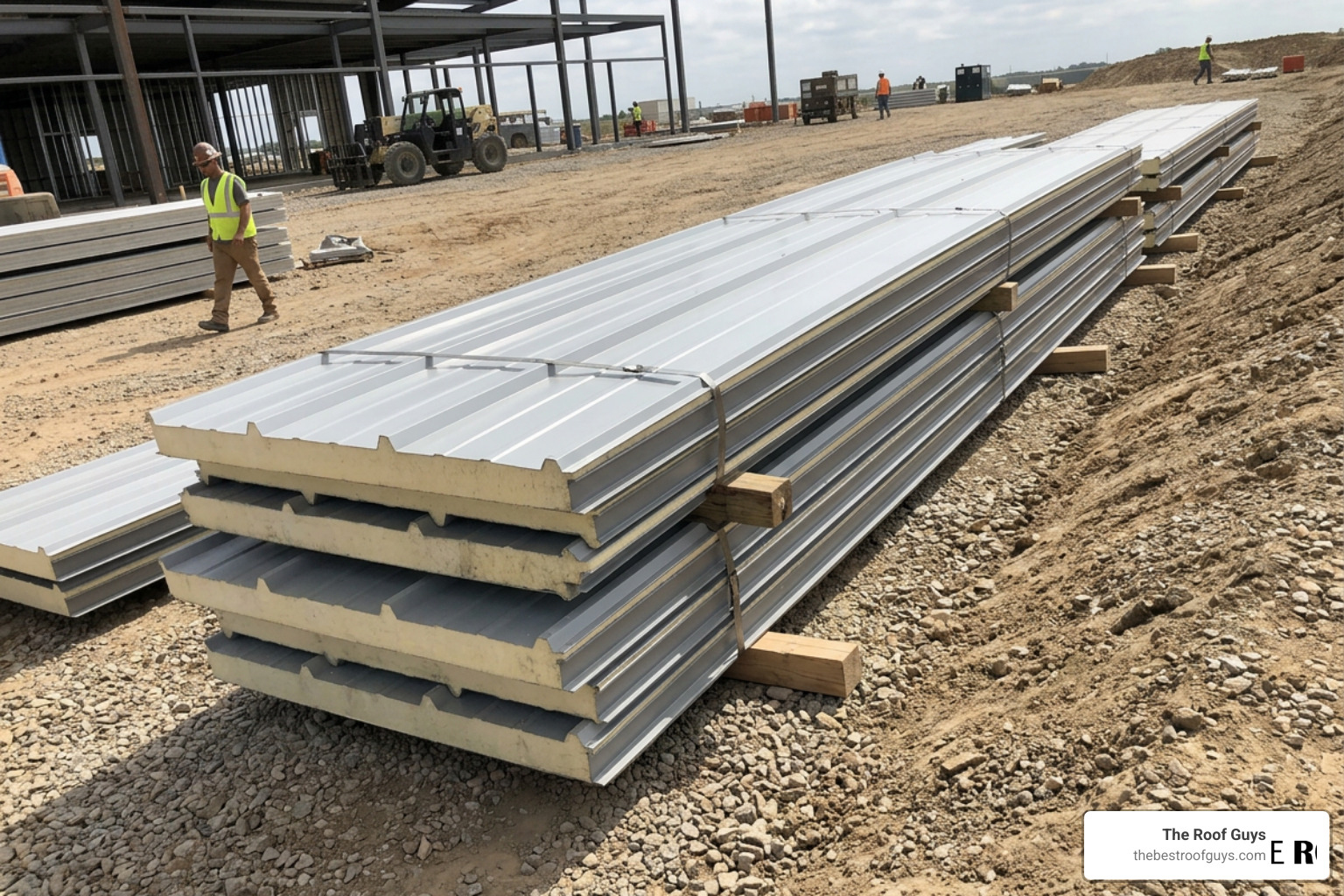
Many panel failures don’t happen because of poor installation; they happen because of bad handling before the panels ever reach the roof. Insulated panels are heavy, long, and susceptible to physical damage and moisture trapping if stored incorrectly.
Unloading and Handling
- Use Spreader Bars: For panel packs longer than 8 meters (approx. 26 feet) or weighing over 1,800 kg, always use a crane equipped with a spreader bar and wide fabric belts. Never use wire ropes or steel chains, which will crush the panel edges.
- Forklift Settings: If unloading with a forklift, set the blades to a minimum width of 48 inches to distribute the weight and prevent the panels from bending or flexing.
- Lift, Don’t Drag: When moving individual panels, lift them vertically from the pack. Never drag a panel across another, as this will scratch the protective coatings and ruin the finish.
On-Site Storage
- Slope the Stack: If storing panels outdoors, place the bundles on a minimum 1:12 slope to prevent rainwater from pooling between the sheets. Water trapped between stacked panels can cause capillary action, leading to wet-stack staining and delamination.
- Keep Them Covered: Use breathable, waterproof covers. Do not store panels uncovered for more than 30 days.
- Watch the Protective Film: Most metal panels come with a protective plastic film. This film must be removed within 4 weeks of installation or 10 weeks of delivery. If left in direct sunlight, the adhesive will bake onto the metal, making it nearly impossible to remove.
To avoid structural bowing caused by uneven heating (thermal bowing), store your panels in shaded areas prior to installation. For more details on handling and transport safety, consult the Delta Panels Handling & Installation Manual.
Step-by-Step Guide to Installing Insulated Roof Panels

Proper installation of insulated panels requires a systematic approach. By following these steps, you ensure that the roof remains completely airtight, watertight, and structurally sound. Understanding this sequence is also helpful if you are researching how roof replacement improves energy efficiency in your home.
Step 1: Preparing the Substructure and Vapor Barrier
Before lifting the first panel, inspect the structural steel or wood framing. Ensure all purlins are clean, dry, and free of burrs.
- Apply Thermal Breaks: If you are working on a cold-storage or highly insulated building, apply PE adhesive sealing tape or thermal breaks to the top of the structural supports to eliminate thermal bridging.
- Lay the Vapor Barrier: For wood-framed or SIP systems, spread a continuous 6 mil vapor barrier (or approved roofing felt) across the entire decking surface.
- Place the Primary Sealant: Run a continuous bead of non-skinning butyl sealant along the structural steel at all panel termination points. This forms your interior vapor seal.
Step 2: Fastening and Sealing the Longitudinal Joints
Once the first panel is aligned perfectly square to the eave and ridge, it must be secured, and the next panel must be mated to it.
- Apply Side-Joint Sealant: Run a continuous bead of butyl sealant in the female leg of the panel joint before mating.
- Engage the Panels: Slide the female joint of the second panel over the male joint of the first. Ensure full engagement without forcing or damaging the joints.
- Stitch the Lap: Fasten the longitudinal side lap using self-drilling stitching screws spaced at a maximum of 500mm (approx. 20 inches) on center.
- Connect the Marriage Beads: Ensure the side-joint sealant connects continuously with the end-lap sealant. This intersection is called the “marriage bead” and is critical to preventing air and moisture bypass.
Step 3: Managing End Laps, Overlaps, and Cutbacks
When your roof run is longer than your maximum panel length, you must overlap panels. This is where many DIYers and inexperienced crews make mistakes.
- Create the Cutback: At the overlap joint, you must remove the bottom metal skin and the foam core of the top panel to create a clean, overlapping flange of the top sheet over the bottom panel. The typical cutback length is 200mm to 250mm depending on the roof pitch.
- Apply Dual Sealant Beads: Apply two continuous runs of butyl sealant across the top of the lower panel before sliding the upper panel’s metal overhang into place.
- Fasten the Lap: Secure the overlap directly through the structural support using the manufacturer’s recommended screw schedule.
For a visual walkthrough of this critical step, you can watch the CFR Roof Insulated Metal Panel Installation: Part 2 – MBCI video guide.
Advanced Detailing: Penetrations, Ridges, and Thermal Performance
Achieving a high-performance roof requires careful attention to detail at all terminations, ridges, and penetrations.
Ridge Conditions
The ridge of an insulated panel roof cannot simply be covered with a metal cap. It must be completely sealed and insulated to prevent thermal bridging and condensation:
- Foam Closures: Install profile-matching foam closures on both sides of the ridge.
- Insulation Packing: Pack the empty space between the panel ends at the ridge with compressible insulation or two-part expanding polyurethane foam.
- Z-Closures: Secure metal Z-closures over the foam closures, sealing them with butyl sealant both above and below before installing the final ridge cap.
Handling Roof Penetrations
Whether you are installing a skylight, a chimney, or a commercial HVAC unit, penetrations must be carefully engineered:
- Use Pre-Formed Curb Units: Never rely solely on sealants to waterproof a curb. Use pre-formed curb units that conform to the roof’s profile and extend from sidelap to sidelap.
- Under/Over Flashing: Always install flashings so they shingle water naturally—running under the panels at the upslope side and over the panels on the downslope side.
- Pipe Seals: For small pipes, use flexible EPDM boots (such as Dektites) secured with compression clamps and sealed with neutral-cure silicone.
“Hot” vs. “Cold” Roof Applications
When installing insulated roof panels, you must decide between a vented (cold) or unvented (hot) assembly.
- Hot Roof (Unvented): The panels are sealed completely airtight, and the roofing cladding (like shingles or standing seam metal) is applied directly over the panels or sheathing. This keeps the entire attic space conditioned.
- Cold Roof (Vented): Structural battens (2×2 or 2×4 sleepers) are installed on top of the sealed panels, creating a ventilated air gap beneath the outer roofing material. This is highly recommended in hot climates like Texas to allow heat to escape before it reaches the insulation core.
For structural wood-based systems, you can find complete engineering details in the Insulspan Installation Guide.
Frequently Asked Questions about Installing Insulated Roof Panels
What is the minimum roof pitch required for insulated metal panels?
For single, continuous panels running from ridge to eave, the minimum pitch is 7% (4°). If your roof design requires transverse joints or end laps, the minimum pitch must be increased to 10% (6°) to ensure proper drainage and prevent water back-up.
How many screws are required to secure each insulated roof panel?
For standard structural insulated roof panels, it is recommended to use 9 to 12 screws per panel. These fasteners must be long enough to achieve at least 2 inches of penetration into the underlying structural wood or steel purlins.
Can insulated roof panels be used for both hot and cold roof applications?
Yes. In an unvented “hot” roof application, sheathing and roofing materials are applied directly to the sealed panels. In a vented “cold” roof application, vertical battens are attached to the panels first to create a continuous air gap, which helps dissipate solar heat gain in warm climates.
Conclusion
Installing insulated roof panels is a highly effective way to improve your property’s energy efficiency, structural strength, and comfort. However, because these systems combine your roof deck, insulation, and ceiling into a single component, there is zero margin for error during installation. Misaligned panels, poor sealant application, or incorrect fastener spacing can compromise the entire system.
Whether you are looking to install a new insulated patio cover in Conroe, replace a storm-damaged commercial roof in Houston, or build an energy-efficient home in Tulsa, our experienced crews are here to help.
At The Roof Guys, we bring decades of experience, ultra-fast turnarounds, and our signature 10-year workmanship warranty to every project. We understand the unique challenges of the Texas and Oklahoma climates, and we know exactly how to build roofs that stand up to the heat and storms.
Ready to get started on your roof upgrade? Visit our professional roof installation services page to schedule your free consultation!