
Roof Repair Services with Roof Leak Detection and Emergency Roofing Help
When you need roof repair services, whether it’s a fast-moving leak, missing shingles after a storm, or recurring water stains, The Roof Guys helps you get answers and a repair plan that solves the root cause (not just the symptom). Texas roofs take a beating: NOAA’s disaster tracking shows Texas was affected by 190 separate $1B+ weather and climate events from 1980–2024, averaging 4.2 events per year across that period and 13.6 per year in 2020–2024.
If you want a quick, no-pressure starting point, book a free inspection today.
Roof Repair Services That Stop Leaks and Prevent Bigger Damage
A roof leak isn’t only about the drip you see, it’s about what moisture is doing where you can’t see it. Water can travel along decking, rafters, insulation, and drywall before it appears indoors, which is why a “small” leak can turn into a bigger repair footprint if it’s left alone.
Moisture also creates the conditions for mold quickly. The EPA notes that drying water-damaged areas within 24–48 hours helps prevent mold growth, one reason roof leaks should be treated as time-sensitive.








Signs You May Need Roof Repair
Often points to active intrusion that may be traveling from a penetration, valley, or flashing point before it shows up indoors.
Wind can push water into vulnerable edges and flashing gaps that don’t leak in calm conditions.
Missing or lifted shingles expose underlayment and fasteners, increasing leak risk.
Granule loss can signal shingle wear and reduced UV/weather protection, sometimes accelerated by hail or age-related brittleness.
These can be signs of ongoing moisture exposure, not just a one-time event.
Persistent dampness can indicate a roof leak, ventilation issue, or both.
Roof Leak Detection
Roof leaks in Texas and Oklahoma often follow severe storms, high winds, hail, and sudden temperature swings. The stain on your ceiling isn’t always directly below the actual entry point. Water can travel along decking, rafters, and insulation before becoming visible indoors.
Our roof leak detection process focuses on identifying the true source by inspecting flashing, penetrations, valleys, and shingle transitions common in regional roofing systems. Accurate leak detection prevents repeat issues and ensures your roof repair addresses the root cause for long-term protection.
What’s Included in Our Roof Repair Services
Every roof is different, but dependable roof repair services should always include clear diagnosis, the right scope, and detail-focused execution, especially at penetrations and transition points.
- Leak investigation and moisture tracing: We connect interior symptoms to exterior entry points to avoid “fixing the wrong spot.”
- Replacement of damaged materials: We rebuild affected areas (missing, cracked, lifted, or impact-damaged components) to restore protection.
- Flashing repair or replacement: Because flashing is a common leak origin, we focus on chimneys, vents, wall tie-ins, and valleys.
- Sealing at critical points (when appropriate): We reinforce watertight seals using roofing-appropriate methods, not shortcuts.
- Underlayment/decking evaluation (as needed): If underlying layers are compromised, we identify what must be corrected for the repair to hold.
- Photo documentation: Helpful for decision-making and keeping a record of findings.
For planning and comparison, request a roofing estimate.
Common Causes of Roof Leaks We See Most Often
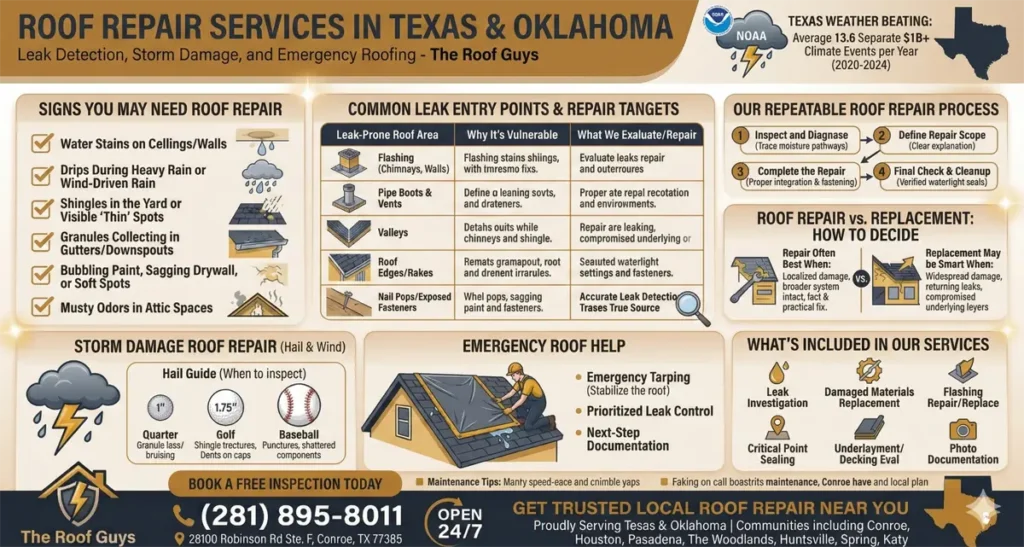
Most roof leaks start at transitions, places where materials meet, change direction, or get penetrated. The table below highlights common leak entry points and what a proper repair typically addresses.
Common Leak Entry Points and What a Quality Repair Targets
Leak-prone roof area | Why it’s vulnerable | What we typically evaluate/repair |
Flashing (chimneys, walls, skylights) | Seams + movement + old sealants | Rebuild or re-integrate flashing details and water-shedding laps |
Pipe boots & vents | Rubber cracks, collars lift, fasteners loosen | Replace boot/flashings; reseal and re-secure per roof type |
Valleys | High water volume + debris buildup | Clear debris, correct valley details, replace damaged materials |
Roof edges/rakes | Wind uplift breaks shingle seals | Replace lifted/damaged shingles and reinforce edge transitions |
Nail pops/exposed fasteners | Expansion/contraction backs fasteners out | Reset/replace fasteners and restore watertight surface layers |
If the leak source isn’t obvious, leak detection can help pinpoint it before repairs begin.
Our Roof Repair Process
A lasting repair follows a repeatable process: inspect, diagnose, repair correctly, and verify.
1) Inspect and Diagnose
We inspect the roof surface and the areas where leaks commonly start (penetrations, flashing, edges, valleys). When helpful, we correlate findings with attic-side observations to confirm moisture pathways.
2) Define the Repair Scope
You’ll get a clear explanation of what’s damaged, why it’s leaking (or likely to leak soon), and the repair approach that best restores water-shedding performance.
3) Complete the Repair
We focus on detailed work that matters: proper flashing integration, correct fastening, and clean “laps” that direct water away from your home.
4) Final Check and Cleanup
We verify the repaired area is sealed correctly and leave the site clean.
Want to see our workmanship style? Browse the project gallery.
Why Choose The Roof Guys
You deserve roof repair services that are easy to understand and built to last. Homeowners choose us for:
- Clear communication and straightforward recommendations
- Detail-focused repairs at the points that leak most often
- Respect for your home and a clean job site
- Helpful documentation and next-step guidance
See what customers say in testimonials, or learn more about us.
Areas We Serve
Licensed Commercial & Residential Roofing Contractor
The Roof Guys – quality materials, expert service, and lasting protection guaranteed.
Storm Damage Roof Repair
In the U.S., NOAA estimates there are about 100,000 thunderstorms each year, and about 10% reach severe levels, which helps explain why hail/wind roof repairs are so common. The table below gives clear thresholds homeowners can use after a storm to decide whether to schedule roof repair services.
Severe Storm Thresholds and Hail Size Guide (When to Inspect Your Roof)
Storm factor | “Severe” threshold or common reference | What roof damage can look like | Recommended action |
Severe thunderstorm (definition) | Hail ≥ 1 inch OR winds ≥ 58 mph (or tornado) | Lifted shingles, loosened flashing, punctures, broken seals | Start with storm services |
Quarter-size hail | 1.00 inch (National Weather Service) | Granule loss, bruising, edge damage | Review hail repair |
Golf ball-size hail | 1.75 inch | Shingle fractures, dents on vents/caps, accelerated leaks | Book a roof inspection |
Baseball-size hail | 2.75 inch | Punctures, shattered components, widespread damage | Request emergency roofing if leaking |
Wind uplift conditions | Often seen with severe storm criteria above | Missing shingles, broken adhesive strips, exposed underlayment | Consider roof repair quickly |
Emergency Roof Repair and Temporary Protection (Tarping)
If water is actively entering the home, stabilization is the priority. Temporary protection doesn’t replace a permanent repair, but it can limit damage while you plan next steps.
- Emergency tarping: A properly secured tarp helps shed water away from vulnerable areas and reduces ongoing intrusion risk.
- Prioritized leak control: We focus first on stopping active water entry, then on restoring the full roof system.
- Documentation for next steps: Photos and notes support the permanent repair plan (and can be useful if you’re navigating an insurance process).
If you need quick protection, request emergency tarping or visit emergency roofing.
What Our Clients Are Saying
We believe the best proof of our service comes directly from the homeowners, businesses, and property managers we proudly serve.
Roof Repair vs. Roof Replacement: How to Decide
The right decision comes down to damage extent, recurrence risk, and the condition of the system beneath the surface.
Roof repair is often best when:
- Damage is localized: A specific section (or a component like flashing) can be rebuilt without compromising surrounding areas.
- The roof is otherwise performing well: When the broader system is intact, a targeted repair can restore watertight performance.
- You need a fast, practical fix: Repairs can often be completed with less disruption than a full replacement.
Roof replacement may be worth considering when:
- Damage is widespread: Multiple slopes or many impact/lift areas suggest system-level issues.
- Leaks keep returning: Repeated problems can indicate aging materials or persistent vulnerability.
- Underlying layers are compromised: Broad underlayment or decking issues can make repeated patching less effective.
If replacement is the better path, explore roof replacement.
Get Fast, Reliable Roof Repair Services in Texas & Oklahoma Today
Don’t let a small roof leak turn into costly structural damage. Whether you’re dealing with storm damage, missing shingles, or active water intrusion, The Roof Guys is ready to respond with expert roof repair services across Texas and Oklahoma. Our team provides detailed inspections, clear repair plans, and dependable workmanship designed to restore your roof’s protection quickly.
Call (281) 895-8011 now to schedule your free roof inspection and get trusted local roof repair near you.
The Roof Guys
Business Hours
Monday: Open 24 hours
Tuesday: Open 24 hours
Wednesday: Open 24 hours
Thursday: Open 24 hours
Friday: Open 24 hours
Saturday: Open 24 hours
Sunday: Open 24 hours
Frequently Asked Questions
Roof repair costs vary depending on the size of the damaged area, roof type, slope, and whether flashing or decking needs attention. Minor shingle repairs may be relatively simple, while storm-related damage can require more extensive work. The Roof Guys provides free inspections so you receive a clear, written estimate based on your roof’s actual condition.
Immediately. Texas and Oklahoma both experience heavy rain, hail, and high winds that can rapidly worsen small leaks. Even a minor drip can spread moisture into insulation and framing. Addressing roof leaks quickly helps limit interior damage and prevents larger repair scopes later.
If the damage is localized and the overall roof system is still in good condition, repair is often the practical and cost-effective choice. However, if damage is widespread or leaks keep returning, replacement may be worth considering. The Roof Guys evaluate the full roof system before recommending the best option.
Many common roof repairs in Texas and Oklahoma can be completed in a single visit once the issue is diagnosed. Larger or storm-related repairs may require additional time depending on material availability and weather conditions. You’ll receive a timeline before work begins.
In Texas and Oklahoma, most leaks start at flashing around chimneys and vents, roof valleys, pipe boots, and areas affected by wind uplift. Extreme heat and temperature swings can also accelerate material wear, making these transition points more vulnerable over time.
It depends on your policy and what caused the damage. In Texas and Oklahoma, storm-related damage like hail or high winds is often covered, while normal wear and tear usually isn’t. Check your policy details and schedule a professional roof inspection to document the damage properly.
Yes. Many roof problems develop silently before visible stains appear indoors. After major storms in Houston, Conroe, Oklahoma City, or surrounding areas, it’s smart to schedule an inspection to catch minor damage before it becomes an active leak.
When damage is addressed early and properly, roof repairs can restore watertight performance and help extend the overall life of your roofing system. Prompt repairs prevent small issues from accelerating wear across the rest of the roof.
How Can We Help?



Our Roofing Services
Why Choose The Roof Guys
You deserve roof repair services that are easy to understand and built to last. Homeowners choose us for:
- Clear communication and straightforward recommendations
- Detail-focused repairs at the points that leak most often
- Respect for your home and a clean job site
- Helpful documentation and next-step guidance
See what customers say in testimonials, or learn more about us.
The Roof Guys
Business Hours
Monday: Open 24 hours
Tuesday: Open 24 hours
Wednesday: Open 24 hours
Thursday: Open 24 hours
Friday: Open 24 hours
Saturday: Open 24 hours
Sunday: Open 24 hours

Get Started
Have questions about your roof? Ready to start your next roofing project? Whether you’re dealing with storm damage, a leaky roof, or planning a complete roof replacement, our team is here to help.
How Can We Help?